It is 9 AM on a Monday morning.
Your sales director just closed the biggest deal of the quarter in Salesforce. She marks it “Closed Won.” She sends a celebratory message on Slack.
And then – nothing happens automatically.
Finance team still does not know the deal exists. They are working from last week’s spreadsheet export.
The warehouse has no idea an order needs to go out. Their system is completely separate from Salesforce.
The customer is waiting for a confirmation email. Someone has to write it manually and send it.
Four departments. Four systems. Zero communication between them.
By the time the order ships, three people have manually re-entered the same data into three different systems. Someone made a typo. The invoice went to the wrong address. The customer called to complain.
Sound familiar?
This is what happens when enterprise software does not talk to each other. And in 2026, it is still happening in thousands of organisations every single day – including ones that have spent millions on technology.
The name for the discipline that fixes this is Enterprise Integration.
Many business leaders assume APIs and enterprise integration are the same thing. They’re not.
An API is simply a communication mechanism that allows two applications to exchange information.
Enterprise integration is the broader strategy of connecting all business systems, data sources, applications, and workflows into a unified ecosystem.
For example:
Salesforce sending customer data to SAP through an API is one connection.
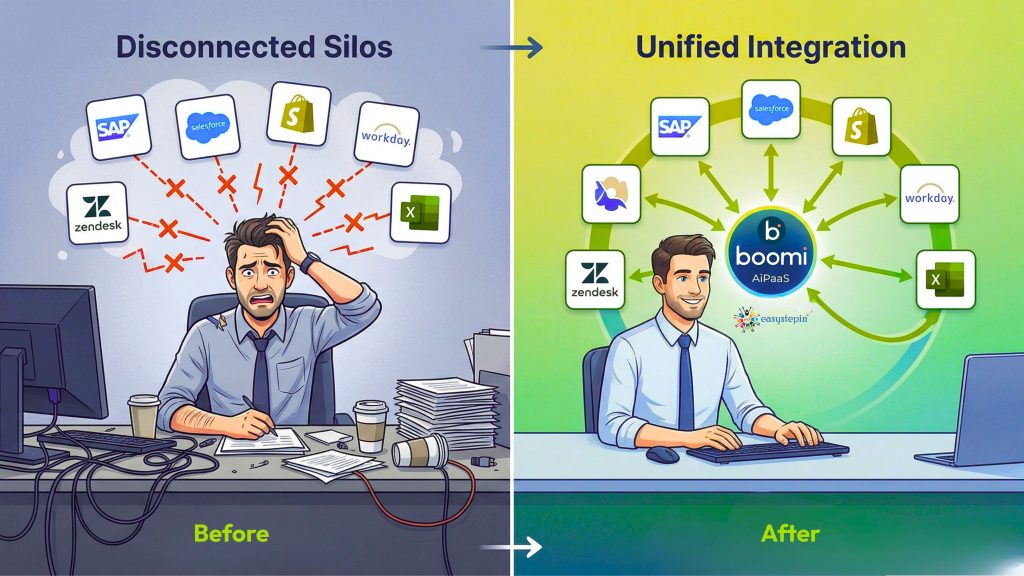
Connecting Salesforce, SAP, Workday, ServiceNow, Shopify, and analytics platforms into a seamless automated workflow is enterprise integration.
APIs are building blocks. Enterprise integration is the complete architecture that ensures data flows securely, reliably, and in real time across the organization.

Let us start with the definition that actually makes sense.
nterprise integration is the practice of connecting your business software systems so that information flows automatically between them - without anyone having to copy it, re-enter it, or manually move it from one place to another.
“Enterprise integration connects all our business systems so data moves automatically between them - eliminating manual work, reducing errors, and making every department work from the same real-time information.”
That is the whole idea.
When a deal closes in Salesforce, enterprise integration automatically creates the order in SAP.
When a new hire is added in Workday, integration automatically sets up their Microsoft 365 email, provisions their laptop access, and adds them to the right Slack channels.
When a customer places an order on your Shopify store, integration automatically updates inventory, triggers the warehouse, and sends the confirmation – all before you can finish reading this sentence.
No human in the middle. No manual step. No delay.
Here is a stat worth pausing on.
The average enterprise today runs more than 200 software applications, according to Okta’s Businesses at Work Report 2025.
Two hundred. Sales tools, finance systems, HR platforms, customer service tools, data warehouses, communication apps, project management software, industry-specific solutions – and counting.
Every time your organisation adopted a new tool to solve a problem, it also created a new silo. A new place where data lives in isolation. A new manual step that a person has to perform to move that data somewhere else.
Ten years ago, when you had 20 systems, this was manageable.
Today, with 200+, it is not.
Without integration, your business is essentially running on human copy-paste as its core data infrastructure.
And human copy-paste breaks in four very predictable ways:

This is the part most IT leaders genuinely underestimate – because the costs are invisible.
Poor enterprise integration does not send you a bill. It hides inside other costs. It distributes itself across every team and every process, quietly compounding every single month.
Here is what the numbers actually look like.
Research by the McKinsey Global Institute found that the average knowledge worker spends 19% of their working week searching for and re-entering information that already exists somewhere else in the organisation.
In a company of 500 people, that is 95 full-time-equivalent positions doing nothing but moving data by hand.
Think about what those 95 people could be doing instead.
When an integration breaks – and without proper management, it will – the impact is immediate. Orders stop processing. Inventory goes out of sync. Customer records become unreliable.
Gartner estimates that enterprise IT downtime costs an average of $5,600 per minute. Integration-related failures account for 30 to 40 percent of all unplanned IT downtime.
A single 2-hour integration outage can cost over $670,000 in direct and indirect losses. Before you factor in the customer trust damage.
When the same piece of information lives in multiple disconnected systems, it will eventually contradict itself. A customer updates their address on your website. The CRM still has the old one. SAP has a third version from three years ago.
The IBM Data Quality Report estimates that poor data quality costs the average enterprise $15 million per year – and the majority traces directly back to data that was never synchronised correctly between systems.
This one is the hardest to see but the most damaging.
Every hour your integration team spends firefighting broken connections and manually reconciling data is an hour they are not spending on digital transformation, AI adoption, or building the capabilities that will differentiate your business over the next five years.
EasyStepIn’s client assessments consistently find that integration teams at enterprises with legacy architectures spend 50 to 70 percent of their time on reactive maintenance – firefighting problems rather than building anything new.
Put it all together, and the MuleSoft Connectivity Benchmark Report estimates that the total cost of poor enterprise integration exceeds $500,000 per year for the average organisation.
Half a million dollars. Every year. Not from one catastrophic failure – from a thousand small inefficiencies, quietly compounding in the background.
💡 The Integration Paradox Most organisations know their systems are disconnected. Most know it is causing problems. But because the costs are invisible and distributed across every team and every process, nobody owns the problem - and it never gets fixed. Enterprise integration is the discipline that finally gives someone ownership of the answer.
Enough theory. Here is what integration looks like when it is working.
A customer visits your Shopify store at 11:47 PM on a Sunday. They check out.
The order sits in Shopify overnight. Monday morning, someone manually creates it in the ERP, emails the warehouse, updates the inventory spreadsheet, and writes a confirmation to the customer. It is Tuesday afternoon before the process is complete.
The moment the customer clicks “Buy Now,” Boomi picks up the event and simultaneously creates the SAP sales order, updates the WMS inventory count, assigns the order to the nearest fulfilment centre, triggers pick-and-pack, and sends the customer a confirmation email with a tracking link.
All of this in under 30 seconds. At 11:47 PM on a Sunday. With nobody in the office.
HR creates a new software engineer’s record in Workday on a Friday.
IT receives an email on Monday asking them to set up the new employee. Active Directory account, Email, Jira, Slack, Laptop request and Software licences. By Thursday, the engineer still cannot access half the tools they need.
The moment the HR record is saved, a Boomi workflow fires. Within minutes: Active Directory created, Microsoft 365 email provisioned, Jira and Confluence access granted with the right role permissions, Slack set up with the right channels pre-joined, IT notified for equipment, and a personalised welcome email waiting in the engineer’s inbox.
They walk in Monday morning ready to work.
Gallup’s research on employee onboarding shows that employees who experience a connected, structured onboarding process are 58% more likely to still be with the company after three years. That is integration paying for itself in reduced attrition.
A global manufacturing company works with 40 suppliers and 8 logistics providers. Without integration, the supply chain team spends 2 hours every Monday manually piecing together where everything is – checking 8 separate portals, cross-referencing spreadsheets, and reconciling conflicting numbers.
With Boomi B2B and EDI integration, every partner sends standardised electronic messages to a central hub. Delivery schedules, shipment notices, and inventory levels populate a single real-time dashboard automatically.
The Monday meeting drops from 2 hours to 15 minutes.
Gartner identifies real-time supply chain data visibility as one of the top three drivers of supply chain resilience – and integration is the infrastructure that makes it possible.

Many organizations start by connecting systems individually.
For example:
Salesforce → SAP
SAP → Warehouse System
Warehouse System → CRM
At first, this seems simple.
However, as the number of systems grows, these connections become difficult to manage, maintain, and troubleshoot.
| Point-to-Point Integration | Modern iPaaS Integration |
|---|---|
| Multiple custom connections | Centralized platform |
| Difficult to scale | Easy to expand |
| Higher maintenance effort | Lower maintenance effort |
| Limited visibility | End-to-end monitoring |
| Error-prone | Automated governance |
Modern integration platforms such as Boomi eliminate this complexity by providing a centralized integration architecture.
Once most IT leaders understand the problem, they ask the same question:
“Why hasn’t this been solved already?”
It is a fair question.
For a long time, fixing enterprise integration was genuinely difficult. Traditional approaches required specialist developers, custom code for every connection, and weeks of work per integration. Every time a connected system updated its API or changed its data format, the connection broke and the whole process started again.
That is changing.
Modern integration platforms – a category called iPaaS (Integration Platform as a Service) – have fundamentally changed what is possible. Where integration once required armies of developers and months of custom coding, modern iPaaS platforms make it possible to connect enterprise systems in days using pre-built connectors and a visual drag-and-drop interface.
IDC research shows that organisations using modern iPaaS platforms reduce their average integration development time by up to 60 percent compared to traditional custom-coded approaches.
The most advanced platforms go even further. AiPaaS – AI-powered iPaaS – adds artificial intelligence to the integration layer, enabling integrations that monitor themselves, predict problems before they happen, and in some cases resolve errors autonomously without human involvement.
This is what EasyStepIn builds for enterprises across Asia – AiPaaS integration architectures on top of Boomi, the world’s leading enterprise integration platform and a consistent Gartner Magic Quadrant Leader for iPaaS.
The next post in this series covers exactly what iPaaS is, how it works, and how to choose the right platform for your organisation.

At EasyStepIn, we help organizations replace fragmented integrations with scalable AiPaaS architectures built on Boomi.
Our services include:
Enterprise Application Integration
SAP Integration
Salesforce Integration
Cloud Integration
EDI & B2B Integration
API Management
Managed Integration Services
AI-Powered Integration Automation
With certified Boomi architects and proven delivery frameworks, we help enterprises accelerate digital transformation while reducing operational complexity.
If any of the following sound familiar, enterprise integration should be a strategic priority:
Teams manually transfer data between systems.
Customer information exists in multiple versions.
Reporting requires spreadsheet consolidation.
Order processing depends on manual intervention.
Employee onboarding involves multiple disconnected workflows.
IT teams spend more time fixing integrations than building innovation.
These are common indicators that disconnected systems are creating operational inefficiencies and limiting business growth.
EasyStepIn is Asia’s leading AiPaaS and integration services provider. We help enterprises connect their systems, automate their data flows, and build AI-powered integration architectures using Boomi – the world’s leading enterprise iPaaS platform.
We are one of Asia’s few Boomi Elite Partners, with 20+ certified integration architects and a track record of delivery for some of the world’s largest enterprises across manufacturing, healthcare, retail, logistics, and financial services.
Want to explore what enterprise integration could look like for your organisation? Book a free 30-minute discovery session with our AiPaaS team →
Disconnected systems slow growth, increase operational costs, and create unnecessary complexity.
EasyStepIn helps enterprises design, implement, and manage scalable Boomi-powered AiPaaS solutions that connect applications, automate workflows, and unlock real-time business insights.